Saturday, November 5, 2011

The Importance of Bread

Here in Mali, I always see kids with yellow-red-ish hair. Or with yellow or red eyes. Everyone's skinny. They want very badly to be fat, but a diet of a few handfuls of rice, millet or bread with sauce actually doesn't do much to get you fat. Because it contains little or no nutrients, essential for adequate development of the brain and body. 

The kids with yellow-red-ish hair are malnourished. The eyes are malaria. The skinniness is lack of adequate nutrients. The wanting to be fat is them wanting to be fat like Americans, because they see it as "rich" if you can eat enough to get "fat." And by fat, I mean not-rail-thin. I'm fat to Malians. 

In a place where people are hungry, where the rainy season stopped very early and we don't know how many nights certain families will go without eating because their crops won't grow now, without rain, food that fills your belly is...pretty important. 

That's where bread comes in. 

I spent about four hours making bread at the little boulangerie down the street from my house. They come in at 1 AM to make the dough. And they work in a perfect team that gets that bread out, steaming hot, to Malian hands first thing in the morning. When hunger will strike early. 

Bread is important because, although its power for filling tummies diminishes quickly, it leaves the stomach full and happy, at least for a little bit. 

While I'm buying a half loaf of bread, loading it with protein-rich eggs and onion and meat sauce, most Malians, especially the kids, will buy a tiny little sliver of bread with a little sauce for flavor. It's always humbling. 

Every time. 

So, here's to the importance of bread. To keeping the bellies full, even for a little bit. 

At the Bouloungerie: 

The bin full of dough. Bajigi is quickly beating the dough into little balls and throwing it on the table to his left for the guy to his left to line up and shape into loaves. 


Typical photo opp. Taking a rest. A lot of times people will just lie down or nap wherever they are.
Dough balls
After Bajigi threw the dough balls on the table for the next guy to beat and shape
Inside of the mud-brick bread oven. It's heated by fire. They see inside of it with a flashlight. These guys are incredible. They feed bread to the entire community without any electricity. Malians are so resourceful.
Now, you can start to see the division of labor. Bajigi is shaping the dough into balls, throwing them on the table, and Traore man is lining them up to shape into actual loaf shape.
That's a lot of dough!
I honestly just took this pic because this guy has really nice arms. Enjoy. 
Arms...I mean, lining up the dough to shape.

Next, they will shape the dough into long, oval shapes.  
In the meantime, some bread was done, so they sent these kids out to sell it in the market. The kids travel around, go to butikis, etc and sell the bread one by one. Price of bread is set here at 50 CFAs (10 cents) for a half-loaf and 100 CFAs (20 cents) for a full loaf.
This is the wheat they used. I took this because I was trying to explain to them that I come from the land of wheat! 
This is my friend, laughing, after I complained that Malians don't smile in pictures. So, he burst out laughing for a shot, haha
After the bread is shaped into loaves, they are separated between this fabric. Next, these wooden slabs are inserted into the huge, mud-brick bread oven to bake for about 5-10 minutes.
Got some more bread to sale! Normally they balance these slates of about 90 loaves of bread on their heads as they travel around. 
Ready to embark on his bread-selling journey
There is no Malian day complete without the constant making of tea!
So, now you see what happens when you're persistent when it comes to smiling in pics! When I showed them this pic, they all burst out laughing. He looks like a crazy guy, but it's a great pic! Here, they're literally beating the bread to turn it into loaf-shapes (behind the guys). 
Dough loaves
Situating the loaves between the fabric to get it ready for baking

Big bag of flour. You get covered in flour in this place!

Bajigi separating the loaves between the fabric


My "brother," a fellow Coulibaly, making the tea for the workers
Smiley throwing some bread into the oven


I tried getting in on the action of beating the bread into perfect loaf-shapes. So, here you go.
They worked so efficiently and productively together. Everyone had their own role, and they worked very fast. It was really cool witnessing this. And I got a bunch of free, piping hot bread when it was done!
Bread in the huge, mud-brick oven
Smiley doing what he does best - baking that bread!
This is who I called "Jam Jam Ba" - which means "really tall" - he kept proposing to me and telling me he was going to cut my neck (sounds really creepy, but it's what joking cousins say to each other - don't be alarmed!!!!). We all just made fun of him the entire time!

Almost done for the day!
The kids carting out a huge trunk full of at least 200 loaves of bread to sell. Here, kids get to do work like this. It's their role in society. 

Ready to eat
Here, he is wiping down the bread to get ready to sell
Off to sell a bunch of bread

Sunday, October 9, 2011

PICTURES-Making Bogolan at Si Nafa

Life has been good here in Kita. I've done many things from which I've learned a great deal - selling things in the market, doing accounting with Malians, making bogolan, attending a shea formation, making soap, hiking the Kita mountain, cooking with Malians, starting my radio show, going on "chat tours," drinking tea with random people and observing the transactions at local butikis.

I also have to find balance here. I have two services - the women's sewing school and Si Nafa. So, I have to balance my time, switching between the two workplaces while getting to know the rest of Kita. It's hard, and it's a lot of work. 

I'm working almost the same hours as I was back in the States (when I wasn't working 80-100 hours per week, of course). Usually I'm out in my community from 9 AM to 5-6 PM. I try to have an open mind and will try anything with Malians. Making Bogolan at Si Nafa gave me an understanding of just how tedious and time-consuming making Bogolan is. 

In this blog, I have a bunch of pictures that I hope detail what life is like at one of my workplaces - Si Nafa. You also get to see how to make Bogolan. It's a fascinating process!! Enjoy!

This is Sabou, the president of Si Nafa, her son, Younousa, and me. 
This is Sabou, the president of my women's shea cooperative. Sabou is the Malian version of Wonder Woman. She has more skills than any other Malian I've met, and she's a powerful woman in my community. 
This is Baba. I've written about him in this blog twice before. He's taking an afternoon nap here. 

This is called "Toubab soap" and it's one of the highest selling products my service has. Women buy this to wash dishes, clothes, etc.


This is the nyegen at Si Nafa. Sometimes people pay them to use it - usually about 25 CFAs - or the equivalent of 5 cents.
Playing the Malian version of cards - "Crazy Eights"

This is one kind of shea soap my service makes and sells.
This is inside Si Nafa's "magasin," or store. They use it for storage of shea, soap and rice. In these bags are the packaging bottles for their shea butter. Their shea butter sells for keme fila, or 1,000 CFAs, which is equivalent to $2, but it is a lot of money to the average Malian.

I like doing art and drawing time with kids because it helps them practice art, creative thinking and expressing themselves. Unlike in the States, they don't have a big push for creative and critical thinking and art in schools. This is me and Younousa, Sabou's son, drawing hands, chairs, cameras and stars. 


Braiding little Kunba's hair. Kunba cried non-stop while getting her hair braided. This is my friend who works at Si Nafa, and braids women and girls' hair for a living.


"Buy some meat!"
Yum Yum Yum! Don't know what all these body parts are, but they're for sell! I usually don't partake :)
This is the Baobab tree candy my service makes. I've gotten all the PCVs hooked on it here. It has Baobab powder (below), honey, sugar and water and something else in Bambara that I didn't understand. Baobab is so good for you. It has more antioxidants than acai berry, more calcium than milk, more magnesium than spinach, more potassium than bananas, more iron than red meat, is good for your immune system and preventing diseases, gives you a burst of organic energy and helps to replenish the nutrients lost in your body after something like a workout. It's called the "Tree of Life" here in Africa. 
This is the Baobab fruit powder my service sells. You can cook with Baobab powder. Add it into your water after a workout to replenish your body's nutrients and give you a jolt of energy. I add it to my water and immediately feel better, no matter what I am doing. It's like a miracle powder. 
UM Just straight cute. Malians don't naturally smile in pictures, so when I am taking them, I am very stern about forcing people to smile! But these girls were modeling the Bogolan for me and we were laughing, so I got this awesome photo. 
THIS is Bogolan. Isn't it awesome? This is a project a couple of volunteers before me did, of Africa and Mali, all in pieces of Bogolan. I want to make at least one of these to bring back home when I'm done. Isn't this awesome?? And it's hand-made in Mali. By women, it supports women financially, allowing them to make their own money and gain self-confidence from selling something they worked hard to make. It's made from fermented mud that's special and gathered at the base of the Niger River. The mud probably took weeks to become perfect, as it had to dry under the hot, Malian, desert sun to grasp the color. How cool!
This is the other one, the map of Mali. 
Bogolan sold at my service - Si Nafa
It's a shea butter coop - here's some of the shea they sell. It's in the old packaging they no longer use. 
My service can make jams.
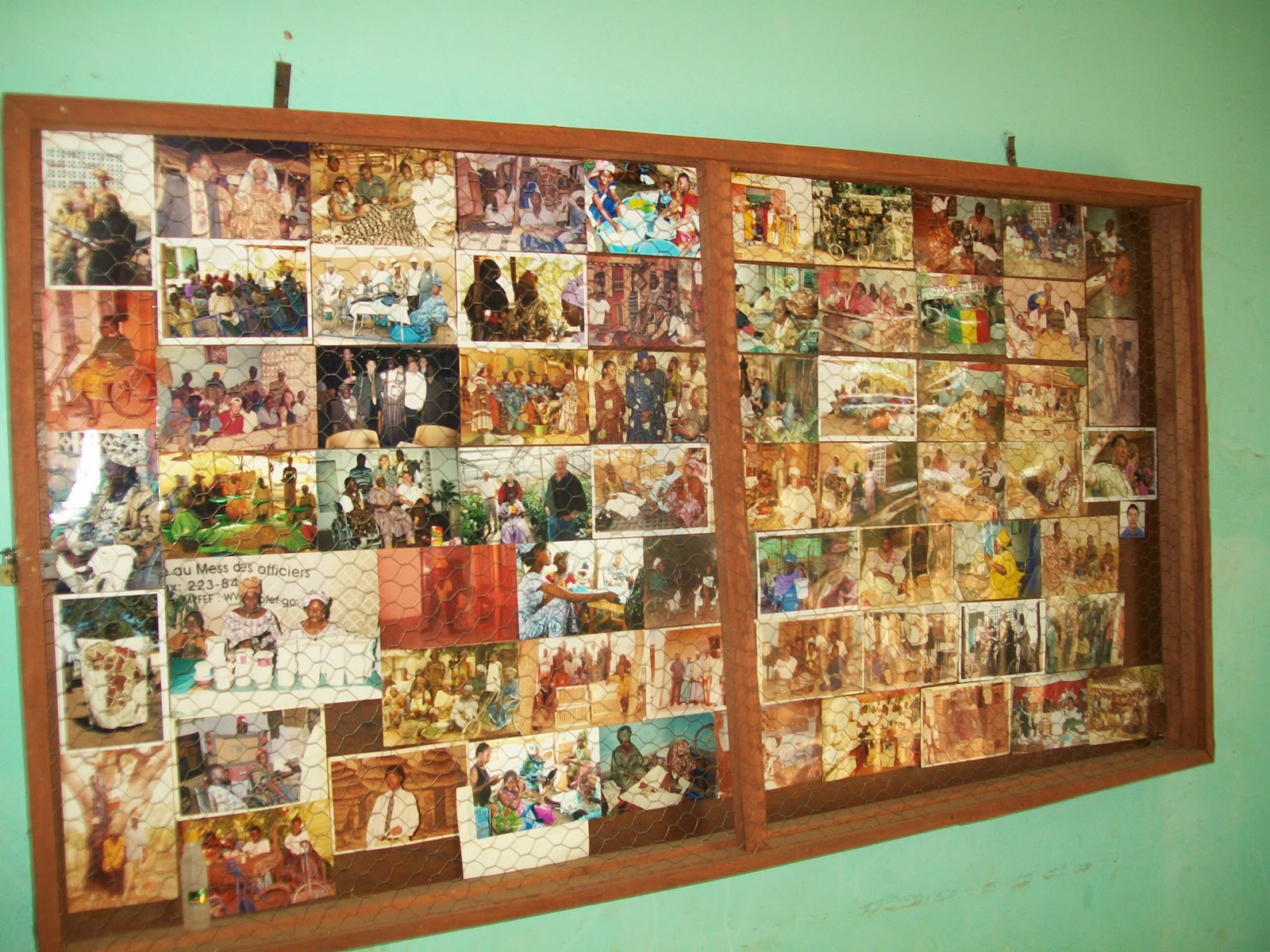
Pics of Peace Corps volunteers, trainings, other NGOs who have helped them. A lot of Malians will introduce you to their photo albums and show you pics of them and their kids throughout their live. And they don't smile, so you have to tell them to smile!
MAKING BOGOLAN, THE MUD-DYED FABRIC OF AFRICA
These are leaves they gather here in Mali. First step, acquire a certain type of fabric that's yellow-whiteish. Boil these leaves. Dip the fabric in the leaves. Let the fabric dry under the Malian sun. Dip the fabric again. Let dry. Dip again. Let dry. Do that seven times to establish the base color for Bogolan.
Boiling the leaves
First, boil the leaves in water. Then separate the water.
Separating the leaves from the water.
That's a sifter they use for cooking, and in this case, taking the leaves out.
Add more water to the leaves to boil another batch for more fabric.


Add the fabric to the boiled leaf water.
Add fabric to the dyed water. It smells like fresh boiled tea.
Stirring the fabric in the water to make sure we completely soak the fabric in dye.
The dyed fabric drying under the sun. We must do this another six times per piece
This is Sabou applying the mud. You have to beat the mud into the fabric with a big paint brush, or sometimes, sticks. The beating ensures the mud won't leak out of the stencils. They have a huge trunk of probably hundreds of stencils for their work.
This is almost finished Bogolan. You can see the mud caked on the fabric. They have to re-apply the mud over and over, and it takes hours, even days. 
Finished Bogolan. It just has to be washed now. Then, it's ready to sell!